India Semiconductor Tracker: Commercial & Research Facilities
Tracking commercial volume production units and strategic research fabs
The Story So Far
India imports nearly all its semiconductor chips — a vulnerability exposed by the global chip shortage of 2020-21. In response, the government launched the India Semiconductor Mission (ISM) with an initial outlay of ₹76,000 crore to build domestic manufacturing capacity.
As of October 2026, 4 of 12 approved commercial facilities are now operational. India’s first fab — the Tata-PSMC plant at Dholera — is under construction. Total approved investment across all ISM projects stands at ₹165,685 crore across 6 states.
But the hard part is just beginning. Assembly and packaging projects are moving fast, but the budget data shows a significant gap between allocated funds and actual disbursement — especially for fabrication. India’s fab ambitions target mature 28nm-55nm nodes, a deliberate strategic choice that avoids the cutting edge but addresses the chips India actually needs.
This tracker monitors every facility in real time. Explore the map below, or dive into the timeline, technology context, or budget analysis.
Recent Developments
- Sep 2026 — Company guidance (CEO Raghu Panicker): Unit 2 at Sanand targeted to become operational in December 2026, including a ~$50 million automotive-grade reliability and failure-analysis lab — one of the first of its kind in Asia, starting with automotive qualification before expanding to space-grade semiconductors. Forward guidance, not yet confirmed by an inauguration. (Kaynes Semicon OSAT Facility)
- Sep 2026 — IndieSemiC (fabless design startup) and Kaynes Semicon sign an MoU for OSAT collaboration — qualification, assembly, and testing of QFN/BGA and other packages for IndieSemiC’s low-power SiP modules and discrete devices, plus joint work on design-for-manufacturability and new package introduction (Kaynes Semicon OSAT Facility)
- Sep 2026 — Tata Electronics and Kelington Group (Malaysia) sign MoU; Kelington to supply ultra-high-purity process piping and critical fab infrastructure/gas-delivery systems to accelerate the fab’s operational readiness (Tata Electronics Semiconductor Fab)
- Sep 2026 — Tata Electronics and Sumitomo Chemical sign MoU to explore supplying the Dholera fab with photoresists, functional chemicals, and high-purity chemicals (hydrogen peroxide, isopropyl alcohol, ammonia water, sulfuric acid), and to explore Sumitomo manufacturing semiconductor materials locally in India — no India facility or investment committed yet (Tata Electronics Semiconductor Fab)
- Sep 2026 — Tata Electronics and FUJIFILM sign MoU; FUJIFILM to invest ~₹800 crore in a semiconductor-materials plant in Dholera SIR to supply high-purity chemicals (e.g. photoresists) for the fab, and to work with Indian chemical manufacturers to localise raw-material production (Tata Electronics Semiconductor Fab)
Facility Map
Commercial facilities approved under the India Semiconductor Mission (ISM) are coloured by type. Strategic and academic research fabs are marked in Slate Grey. Non-ISM OSAT projects are in Teal.
Summary: Commercial Units (ISM Approved)
12 Commercial units
₹177,720 Planned investment (crore)
3 Research/Strategic fabs
4 Operational (Commercial)
Planned Investment by Facility Type (Commercial)
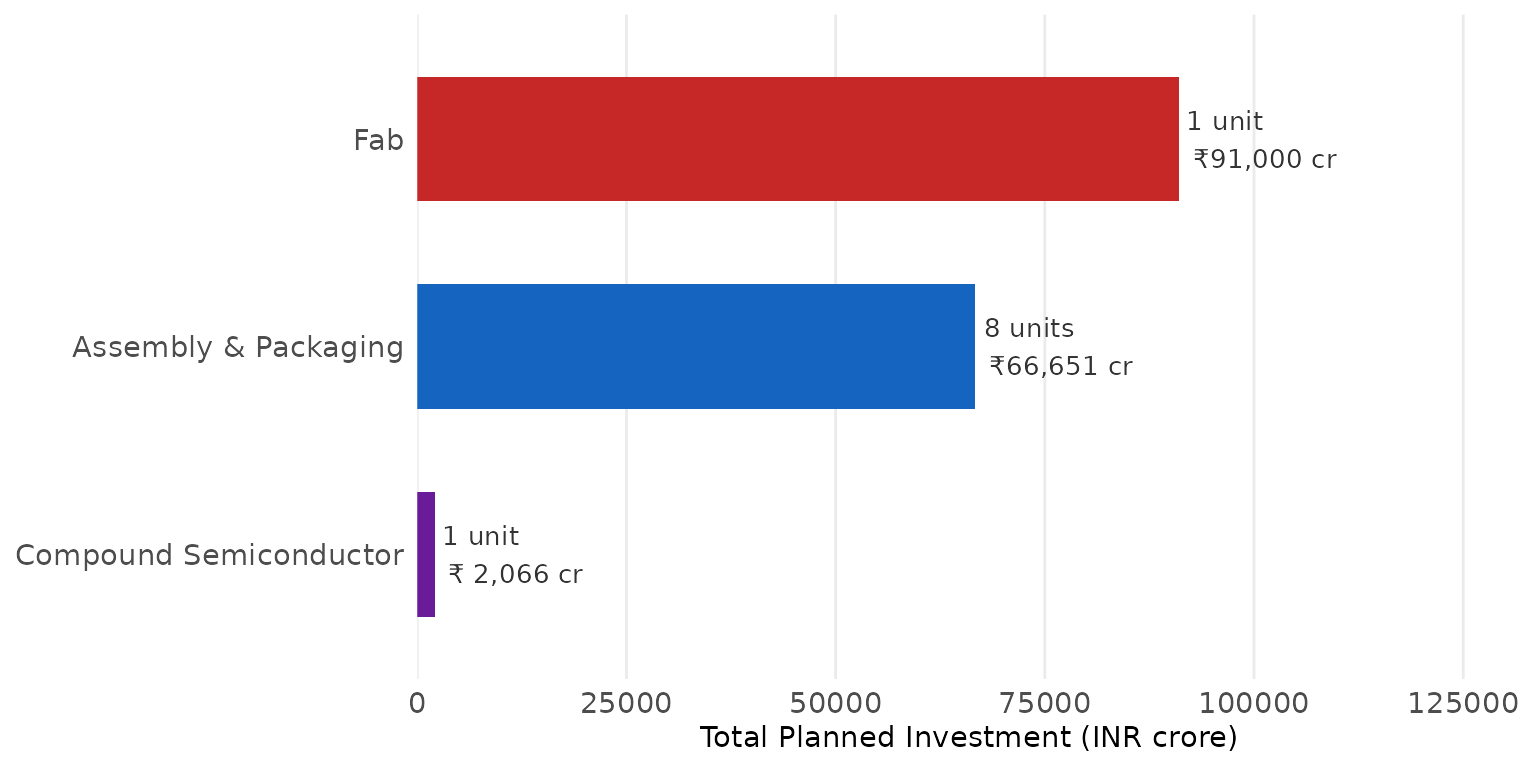
All Facilities
NoteUnderstanding the Metrics
- Technical Complexity: A weighted score combining Technical Difficulty (55%) and Capital Intensity (45%). Benchmarked against a 3nm fab (5/5).
- Slippage: The delay in months calculated from the original announced/expected completion date compared to the current actual or expected date.
NoteComplexity Index
Scores are benchmarked against a cutting-edge 3nm fab (e.g. TSMC Arizona) which would score 5/5 on all three dimensions — technology difficulty, foreign dependence, and capital intensity. India’s current projects are substantially less complex than that frontier. A 28nm fab scores ~2.9/5; standard assembly and packaging facilities score ~1–1.5/5. See the About page for full methodology.
NoteData Source
Data from the SEMICON India 2025 government factsheet (September 2025) and PIB press releases.
TipHave an update?
Know about a status change, a new announcement, or a correction? Submit an update via our form — it takes 2 minutes, no account required. Or open a GitHub Issue for detailed contributions.