Policy & Budget
Tracking government spending on India’s semiconductor industrial policy
This page tracks budgetary allocations for India’s semiconductor industrial policy schemes — from the Union Budget’s Budget Estimates (BE) to Revised Estimates (RE) and actual expenditure. The gap between what is budgeted and what is actually spent reveals where policy intent meets implementation reality.
NoteSource
This analysis was originally published in #IPW 2: Budget Takeaways by Pranay Kotasthane. Budget data is from Union Budget documents (FY23–FY27).
Policy Timeline
India’s semiconductor industrial policy has evolved through three distinct phases:
| Date | Event | Details |
|---|---|---|
| Dec 2021 | ISM 1.0 launched | ₹76,000 crore outlay to build domestic semiconductor manufacturing. Schemes for fabs, ATMP/OSAT, display fabs, and the Design-Linked Incentive (DLI) scheme for fabless startups. |
| Sep 2022 | ISM 1.0 revised | Scheme restructured after initial rounds attracted limited credible interest. Modified Semicon India Programme with revised incentive structures and eligibility criteria. |
| Jul 15, 2026 | ISM 2.0 approved | Union Cabinet approves Semicon 2.0 with ₹1,27,500 crore outlay — a six-pillar strategy covering design, equipment & materials, new fabs, ATMP expansion, R&D, and talent development. Programme timeline extended from 5 to 12 years. |
ISM 2.0: Six Pillars
The Union Budget 2026–27 announced India Semiconductor Mission 2.0, and the Union Cabinet chaired by PM Modi approved it on July 15, 2026 with a total outlay of ₹1,27,500 crore.
ISM 1.0 progress at the time of ISM 2.0 approval: 12 manufacturing units approved with cumulative investment of over ₹1.64 lakh crore — one silicon fab, one silicon carbide fab, an integrated GaN Micro LED display fab, and nine packaging units. Three companies (Micron, Kaynes, CG Semi) had started commercial production. On the design side, 24 semiconductor design projects had been approved for financial support and 105 startups/MSMEs granted access to industry-standard EDA tools.
The six pillars of ISM 2.0:
Design — Build on the initial DLI success. With 105 startups already developing chips, the focus shifts to deepening the design ecosystem — developing IPs, chip designs, and systems to position India as a key semiconductor design IP country.
Machines & Materials — Incentivise companies involved in manufacturing and R&D of semiconductor equipment, materials, chemicals, and gases. This lays the foundation for sustainable growth and develops India’s precision manufacturing industry.
More Fabs — With the first fab (Tata-PSMC Dholera) scheduled for commissioning in 2028, attract more manufacturers to set up silicon fabs, compound semiconductor fabs, discrete component fabs, and display fabs in India.
Strengthening ATMP/OSAT — Build on ATMP success by encouraging advanced packaging technologies, as the world increasingly looks at India as an alternative ATMP/OSAT location.
Research & Development — Move beyond the initial 28nm–110nm nodes toward more advanced nodes and technologies, in collaboration with leading R&D centres within and outside India.
Talent Development — Scale up the training pipeline: 315 universities already train students on chip design using EDA tools, with ~68,000 students trained. Deepen this further and expand into clean room, fab construction, and ecosystem training.
Cumulative Budget: Allocated vs Actual Spending
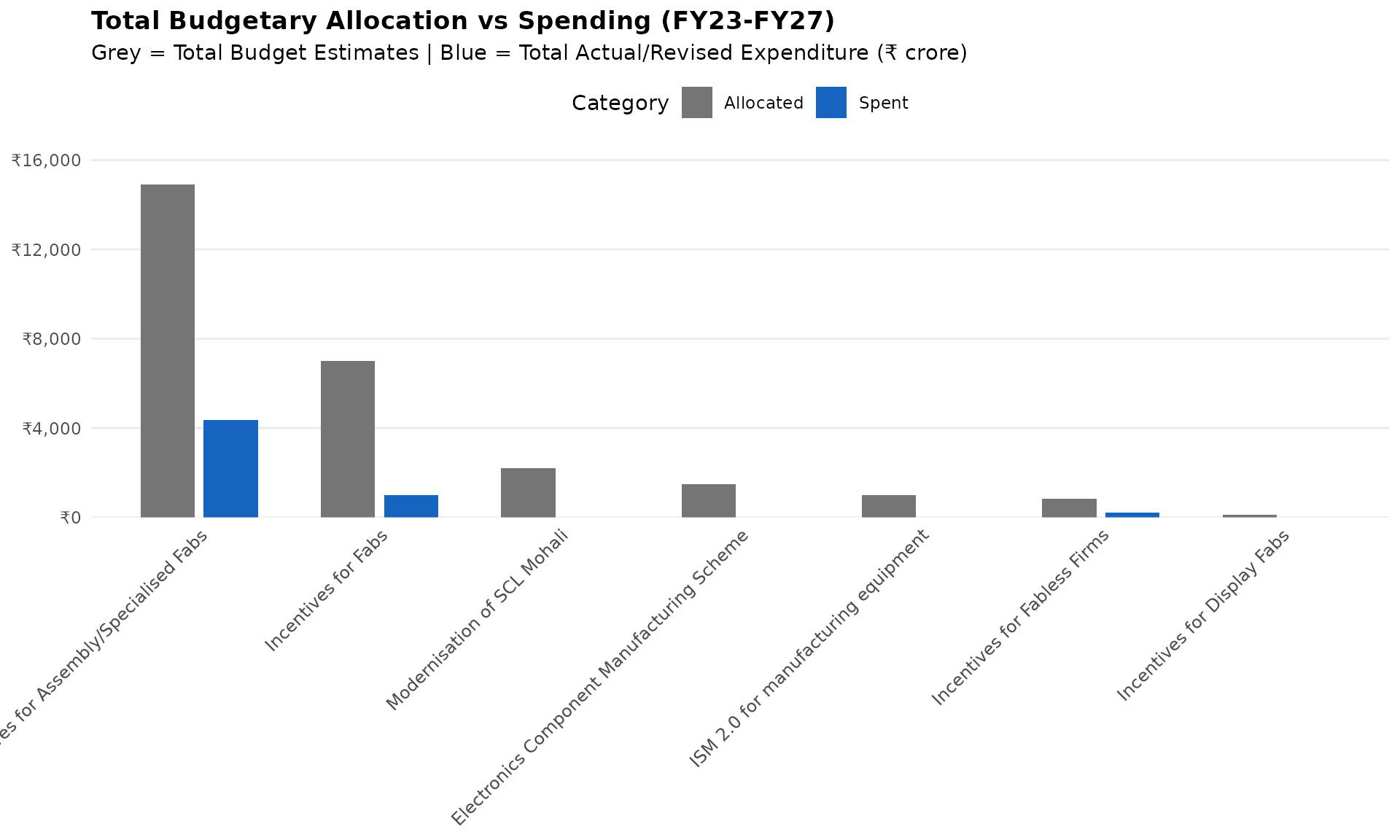
This chart consolidates all budgetary data from FY23 to FY27 to show the total “intent” (Budget Estimates) versus the “reality” (Actual Expenditure/Revised Estimates) for each policy scheme.
Budget Utilisation by Scheme
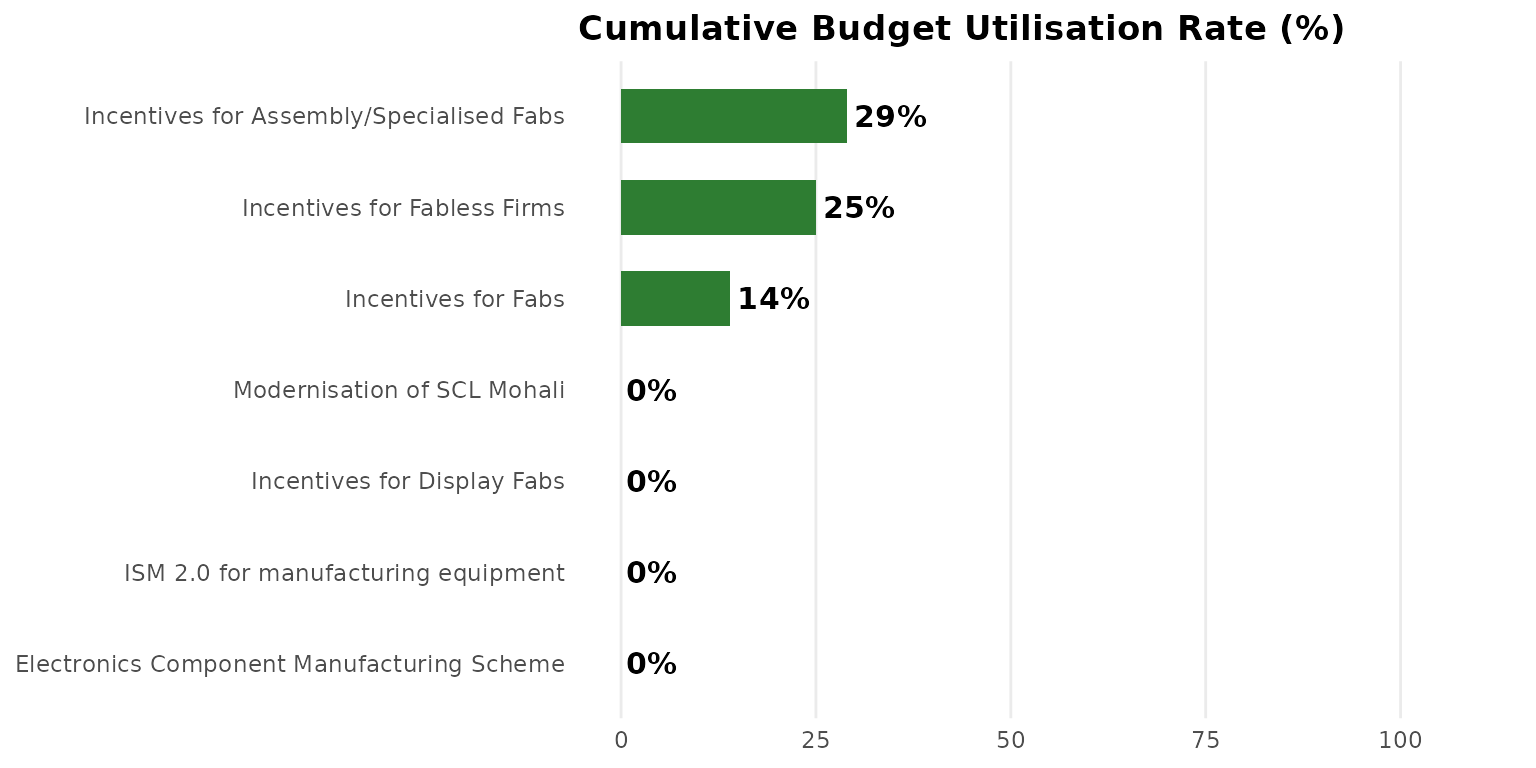
The percentage of allocated funds that were actually spent. Low utilisation indicates project delays or structural barriers in the scheme design.
What the Numbers Tell Us: Analysis
The latest union budget identified semiconductors as one of the seven strategic and frontier sectors in which the government wants to strengthen India’s manufacturing presence. The budget speech announced ISM 2.0, which was subsequently approved by the Union Cabinet on July 15, 2026 with a ₹1,27,500 crore outlay to ‘produce equipment and materials, design full-stack Indian IP, and fortify supply chains.’
Every financial year has two relevant numbers: the budgeted estimate at the start of the year and the actual disbursements by the end of the year. If the difference is large, it indicates that the project is not going as planned. If the difference is small or negative, it indicates that the spending matches government expectations.
This difference matters all the more for ISM1.0 because spending under these schemes is supposed to occur on an equal footing with firms during the capital acquisition and construction stages. This is unlike Production-linked Incentives (PLI), where financial support is contingent on production. Thus, a large difference between budgeted estimates and actual spending directly suggests slower-than-expected progress.
In FY27, the government expects to spend approximately ₹8,000 crore—roughly 10 per cent of the total outlay—for projects already approved under ISM 1.0. Breaking down this overall number reveals the health of each of the five sub-schemes.
Assembly & Packaging: The “Low-Hanging Fruit”
The standout performer is Assembly and Packaging. Allocations have risen steadily from ₹1,800 crore to ₹5,000 crore, and real disbursements are finally following. This is where India’s semiconductor story is most tangible—projects like Micron, CG Semi, and Kaynes have moved from paper to production in record time. This segment is less technically complex but vital for building a domestic workforce and proving that India can execute large-scale electronics projects.
The Fab Gap: Allocated but Unspent
The Incentives for Fabs line tells a more sobering story. Despite massive paper allocations, actual disbursement remains near zero. The FY26 revised estimate is also substantially lower than the budgeted allocations. Thus, it indicates that the project is progressing much more slowly than the government’s own projections.
SCL
The government has also been planning to modernise the state-owned R&D fabrication unit at SCL Mohali for several years, with little success. Despite allocating money in multiple budgets, virtually nothing has been spent. In November 2025, a grand ₹4,500 crore modernisation plan was announced, with promises to upgrade the facility to 180nm capability and increase wafer production 100-fold. Yet the pattern of ambitious announcements followed by tepid execution persists.
The Missing Piece
A disappointing news concerns a sector where India’s comparative advantage actually lies: fabless chip design. The Design-Linked Incentive scheme promised to support 100 start-ups in their go-to-market strategy, but disbursals reveal how far off target it remains. There was no disbursement in FY23. FY24 disbursements stood at 15 per cent of the budgeted ₹200 crore. FY25 disbursements reached only 34 per cent of the budget, and FY26 managed 52 per cent. For FY27, the budgeted expenditure stands at ₹100 crore.
The reasons for this chronic underperformance include strict provisions that disqualify firms that raise substantial foreign capital, confusion over the government’s rights to a company’s intellectual property, and the decision to entrust a government company—which is itself a player in this domain—as the nodal regulator. Hopefully, ISM2.0 will resolve some of these constraints.
Not Begun is Half Undone
The display fab scheme has attracted no interest whatsoever, and the government has not budgeted any amount for it this year. Display fabs are not strategically critical, and spending taxpayer money on them merely to reduce imports from China is not sensible. If the government has finally decided to abandon this scheme, it would be a welcome instance of policy pragmatism. Letting private players build display fabs on their own dime if they see commercial merit is a better strategy.
Strategic Pivots: ISM 2.0 & Components
The Union Budget 2026–27 first signalled ISM 2.0, and on July 15, 2026, the Union Cabinet approved it with a total outlay of ₹1,27,500 crore — nearly doubling the ₹76,000 crore of ISM 1.0. ISM 2.0 goes beyond fab construction to cover equipment and materials, design IP, advanced nodes R&D, and talent development across a 12-year programme horizon. For FY27, ₹1,000 crore has been allocated specifically for the equipment and materials pillar, indicating a gradual ramp-up. See the ISM 2.0 section above for full details.
A related scheme is the Electronics Components Manufacturing Scheme, which incentivises the production of electronics components apart from chips, such as resistors and multi-layered printed circuit boards. The Finance Minister cited high demand for this programme and raised its outlay to ₹40,000 crore from ₹22,000 crore, of which ₹1,500 crore spending is planned in the next financial year.
Source Library
Primary sources and official government announcements used for this tracker.